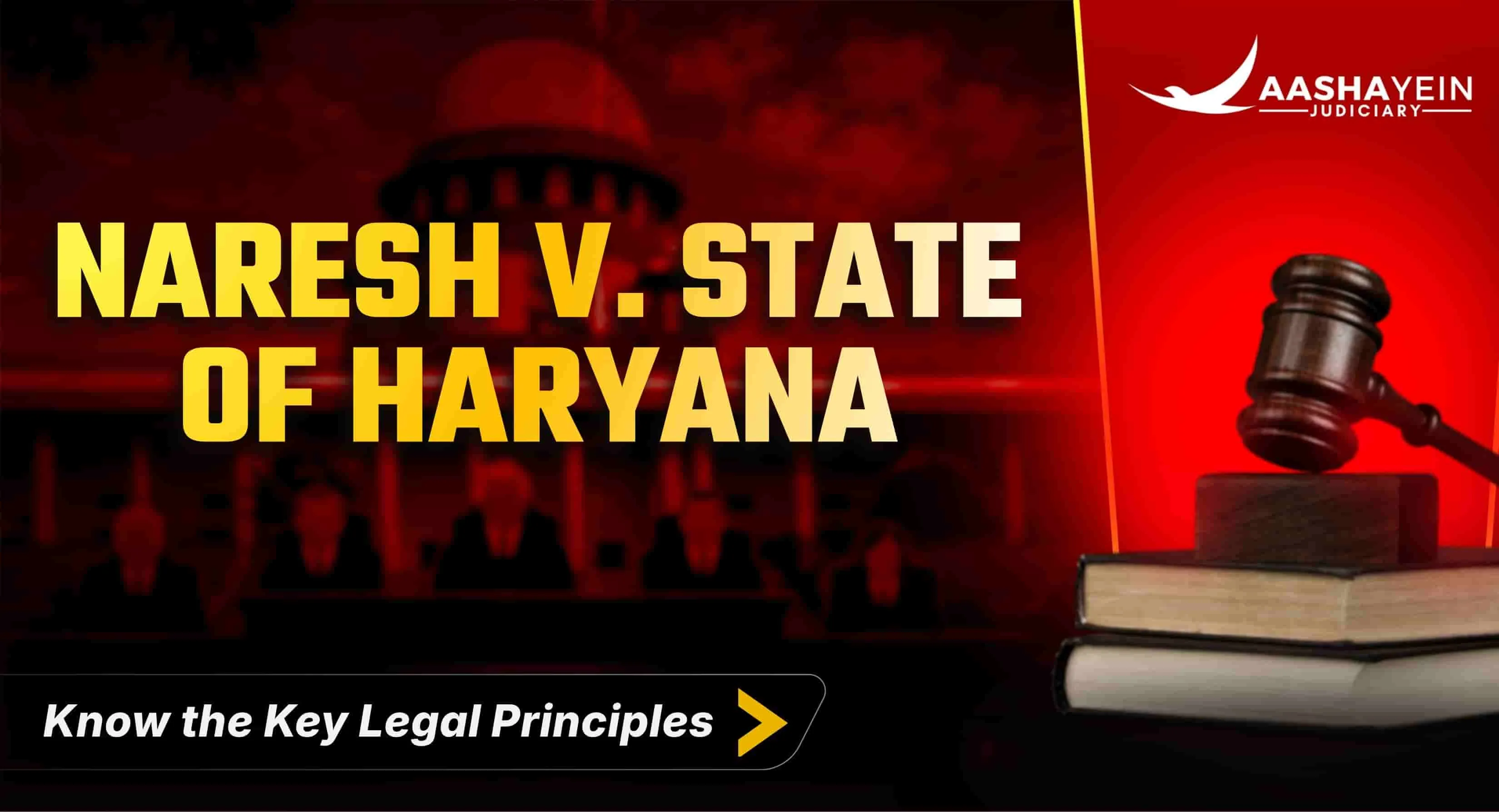
A conviction for an honour killing in Bhiwani, Haryana, in April 2011 was set aside by the Supreme Court. The judgment in Naresh v. State of Haryana, authored by Justice Satish Chandra Sharma and delivered with Justice N. Kotiswar Singh, was reported on 17 November 2026. It is a useful lesson on Section 162 of the CrPC and on recovery evidence.
The core legal point
During investigation, police record statements of witnesses under Section 161 CrPC. Section 162 says these statements cannot be used as evidence at trial, except for limited purposes. The accused can use them to contradict a prosecution witness.
The Court explained the effect clearly. A proved contradiction between the witness's statement in court and the earlier Section 161 statement only impeaches the witness. In other words, it weakens the witness's credibility. It does not turn the old statement into evidence. The Court referred to Section 145 and Section 155(3) of the Evidence Act on contradiction and impeachment.
The Court distinguished Bhagwan Dass v. State (NCT of Delhi) (2011), which had been relied on by the other side.
Also Check: Ashok v Mahesh (2026): Supreme Court Judgment
Recovery evidence
The prosecution also relied on a recovery under Section 27 of the Evidence Act, which allows part of an accused's statement to be proved if it leads to discovery of a fact. The Court held that recovery under Section 27 was not proved in this case.
Result
The conviction was set aside. The case shows what happens when contradictions go uncured and a Section 27 recovery is not properly established.
Exam angle
Keep the three points together: Section 161 statements, Section 162 bar, and contradiction only impeaches. In a problem question, ask: was the earlier statement used to contradict, or as proof? The first is allowed, the second is not.
Frequently asked questions
What was decided in Naresh v. State of Haryana?
The Supreme Court set aside a conviction in a 2011 Bhiwani honour killing, explaining the effect of Section 162 CrPC and holding Section 27 recovery was not proved.
Who authored the judgment?
Justice Satish Chandra Sharma, with Justice N. Kotiswar Singh.
When was it reported?
17 November 2026.
What does a proved contradiction do?
It only impeaches the witness. It does not make the earlier statement substantive evidence.
Which sections of the Evidence Act were mentioned?
Section 145, Section 155(3) and Section 27.
Which case was distinguished?
Bhagwan Dass v. State (NCT of Delhi) (2011).
Where did the crime take place?
Bhiwani, Haryana, in April 2011.
Why is Section 162 important?
It limits the use of police recorded witness statements at trial.
Choose Best Online Judiciary Coaching in India with Aashayein Judiciary. Learn from Nitesh Sir through live classes, concept-based lectures, updated Judiciary Notes, mock tests and PYQs. Get structured guidance and focused preparation for Civil Judge, PCS-J and APO examinations.
Closing note
Naresh v. State of Haryana shows that careful use of earlier statements and proper proof of recovery decide criminal appeals. Revise Sections 161, 162 and 27 together.
At Aashayein Judiciary, Nitesh Sir turns each new judgment into a short exam note. Join our Online Judiciary Coaching and use our Judiciary Notes, PYQ sets and Mock Tests for the Civil Judge Exam, PCS J Exam and APO Exam.

About Aashayein Team
Legal Expert
Start Your Journey
Join 50,000+ aspirants and get access to premium courses, study material, and expert guidance.
Enroll NowView All CoursesFree Resources
Newsletter
Get weekly updates on legal news, judgments, and exam tips.